





 Microsoft Fabric
 SqlDBM Copilot is an AI assistant built directly into the data modeling environment. Instead of acting as an external chatbot, it lives inside the modeling workflow, understands your projects, and works with your existing schemas, objects, and metadata. With it, you can move faster from ideas to models, automate repetitive work, and keep documentation and governance in much better shape.
From Natural Language Requirements to Evolving Data Models
With Copilot, you can quickly transform business requirements written in natural language into an initial data model. By pasting your high-level requirements or pseudo entities into the reverse engineering screen, Copilot analyzes the text, identifies entities, attributes, and relationships, and generates tables in SqlDBM format for direct import into your diagram. This streamlines the process, replacing manual table creation with AI-generated structures and reducing the effort required to interpret complex requirements, allowing you to focus on validating and refining the model rather than creating each element manually. As new use cases emerge and data models evolve, Copilot supports ongoing changes by enabling you to extend an existing model with just the names of new tables or concepts. Because it understands your project’s current context, Copilot can suggest suitable columns and keys for new entities, establish relationships to existing tables, and separate operational, analytical, and reporting layers. You can continue using the same interface to add dimensions, fact tables, or other structures, with the AI referencing your current model as a blueprint and completing the design details, which you can then further customize as needed.

Accelerating Reporting, Documentation, and Model Understanding
Reporting and analytics often depend on a large number of views. These views are simple to describe in natural language, but they are slow and repetitive to write by hand in SQL, especially when they span multiple tables and layers. You must remember the right keys, apply consistent filters, and keep everything aligned with your existing data model. That effort pulls attention away from the business questions you are trying to answer. With Copilot, you can hand off most of that work. You provide a meaningful view name and a short description of what the view should represent, and the assistant uses the context of your SqlDBM project to infer which tables to join, which columns to expose, and how to structure the query. It generates complete SQL for each view that fits your current schema and naming conventions, so you start from a grounded draft instead of a blank editor. After that, you import the views into the diagram, open each definition to verify the logic and performance, then adjust or optimize as needed. View creation becomes a focused review step rather than a coding marathon manually, so your reporting layer stays faster to deliver and easier to maintain.
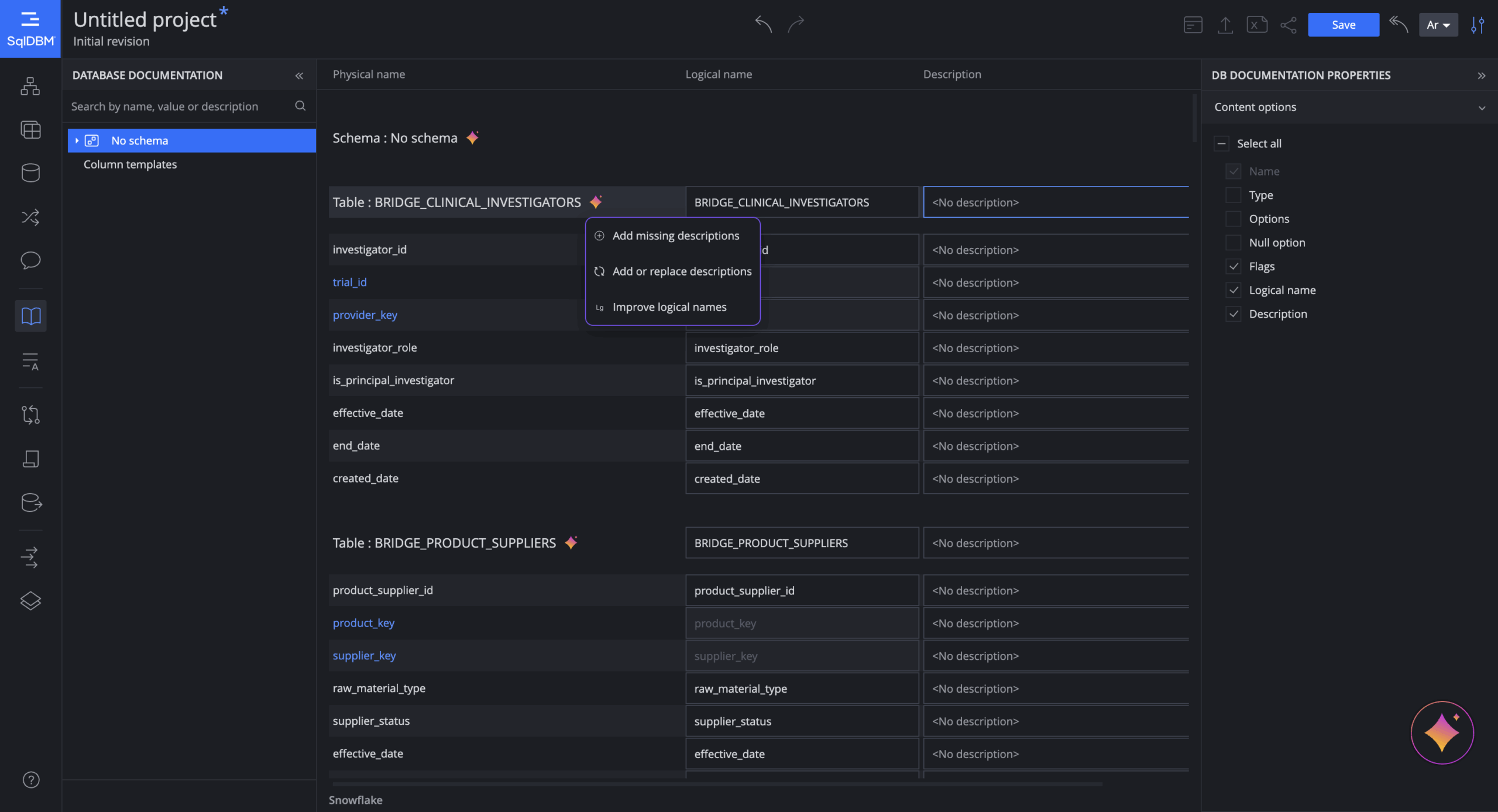
Documentation is essential for collaboration but often neglected because it is tedious, so Copilot focuses on reducing that effort while keeping you in control. It can automatically generate descriptions for columns, tables, and views based on how they relate to each other, fill in missing documentation for a single object or an entire schema, and maintain definitions that are specific to your project instead of generic text. The assistant looks at how objects are connected and where they are used, then creates descriptions that reflect that context, which you can always review and refine. The same understanding of context also helps when you need to dig into a single table or view in detail, especially in a large or inherited model. From the diagram, you can open an object scoped assistant and ask it to explain the business purpose of the object, describe its structure and key attributes, show how it connects to other entities, analyze its impact across related tables and views, or even propose related structures such as child tables or supporting entities. This combination of auto documentation and deep object understanding is particularly useful for complex views or critical tables where you need clarity before making changes.
 Scaling Governance with Adaptable, Organization Aware AI
Beyond individual tables, data leaders need a holistic view of the entire model and its health, and this is where Copilot supports auditing and governance at scale while adapting to each organization’s way of working. It can scan the full project, detect patterns, and highlight issues such as missing primary keys or other important constraints, as well as identify elements that are likely to contain sensitive or PII data and flag them for special handling. At the same time, it can summarize the model into an architecture overview that captures layers, domains, and major relationships, making it easier to share a clear picture with stakeholders and new team members. Because different organizations have different standards, modeling approaches, and languages, these governance capabilities can be tuned through customization. You can define global instructions that apply to every AI interaction in the project, specify whether the model follows Data Vault or dimensional principles, ask Copilot to respect particular naming conventions and terminology, choose a preferred language for all responses, and set custom shortcut prompts at project and object level so your most common checks and tasks are always one click away. As a result, Copilot does not just inspect and summarize your model at scale, it does so in a way that aligns with your standards, governance rules, and communication style.
Conclusion
SqlDBM Copilot introduces an AI layer across the entire modeling lifecycle, bringing intelligence to design, analytics, documentation, and governance in a single environment. It shifts effort from manual construction to guided validation, helping teams move faster while keeping models more consistent and understandable. As Copilot learns from more projects and feedback, its suggestions, checks, and customizations will only grow richer. New patterns, techniques, and use cases can be encoded into global instructions and shortcuts, turning everyday workflows into collaborative work with an assistant. What exists today is a strong foundation, but it is only the first chapter of its evolution.
Learn more and request a demo: https://sqldbm.com/copilot/